May 2017 Archive: Seasonal Party and Baking Posts
By Claire Whitmore · Published · Updated · 4 min read
May sits at a useful point in the party calendar: spring produce is finally reliable, and the first warm-weather gatherings are close enough to plan for. This archive gathers the month's posts on baking and party planning around that window, from choosing flavors that taste right in late spring to keeping frosting intact when the afternoon heats up.
Nothing here depends on a single recipe. The pieces below are the working notes behind the recipes — how much a scratch cake actually costs, how long a baked cake holds, and how to lay out a dessert table that still looks generous for a smaller crowd. Start with whichever problem is closest to your next party date.
Why May Is the Best Test Month for Party Bakers
Late spring is the first time in the year when the kitchen and the party venue disagree. Indoor baking is unchanged, but the room where the cake will sit is warmer and more humid than it was in March, and the gap between finishing a cake and serving it stretches longer at outdoor gatherings.
May also brings a dependable spread of fruit: rhubarb still going, strawberries arriving, and citrus at the end of its season. That overlap makes it a good month to test flavor combinations you will reuse all summer. Bake one cake you know well, change the fruit, and note what the crumb does.
If you are planning the first outdoor event of the year, plan backward from the serving time rather than the baking time. Most failures in May come from a cake that was finished too early, not from a recipe that went wrong.
- Work backward from serving time, not baking time
- Test one new fruit per bake, not a whole new cake
- Note room temperature and humidity alongside your notes
Choosing Cake Flavors for a Late-Spring Menu
The most common mistake in seasonal menus is going too light all at once. A menu of lemon, strawberry, and vanilla reads fresh on paper but tastes thin after a heavy meal. Balance a bright fruit cake with something that has fat and a little salt: brown butter, toasted nuts, or a cream cheese element.
Rhubarb is the quiet workhorse of May. It brings enough acidity to cut through buttercream without the perfume that berries can carry, and it freezes well if you buy too much. Strawberries are better cooked down for a filling than left raw in a layered cake, where they release water and weaken the structure.
If your party runs across several courses, pick flavors that step up in intensity rather than repeat. A light citrus cake first, a rhubarb or berry layer cake second, and a small dark chocolate bite last is a sequence that works for most crowds. Our guide to matching cake flavors to a seasonal menu breaks the order down further.
- Pair bright fruit with a rich element: brown butter, nuts, cream cheese
- Cook berries before using them in a layer cake
- Freeze extra rhubarb for June and July
Frosting Choices That Hold Up in Warm Rooms
Buttercream is the default for good reason, but not all buttercream behaves the same in a 75°F room. An American buttercream with a high sugar-to-butter ratio holds its shape longer than a Swiss or Italian meringue buttercream, which softens faster but tastes less sweet. For an outdoor May party, the sturdier option is usually the right call.
Cream cheese frosting is the exception that needs planning. It is softer at room temperature and less stable over several hours, so it suits a cake that will be served within a couple of hours or one that stays indoors. If your event is outside, save the cream cheese for a sheet cake served from a cooler area.
Whichever you choose, chill the frosted cake for at least 30 minutes before transport. A cold crust holds up to a warm car far better than a freshly finished one. For more on this, see Buttercream vs. Cream Cheese Frosting: Which to Use When and keeping frosting from melting at outdoor parties.
Planning the Dessert Table for a Smaller Crowd
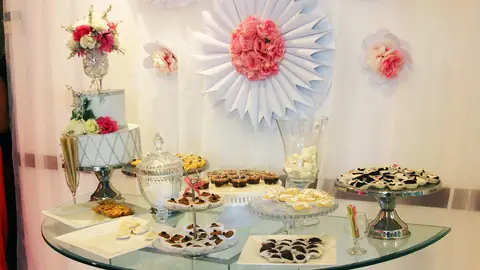
May gatherings tend to be smaller than the holiday events of December, which changes how a dessert table should be built. Fewer people means fewer items, not smaller portions of the same number of items. Three well-made desserts look more generous than six thin ones, and they waste less.
Height is the cheapest way to make a table look full. A stack of books, an upside-down bowl, or a cake stand at one end creates levels without buying anything. Keep the tallest item at the back so it does not block sightlines, and leave a clear path along the front edge for serving.
Keep anything with a soft frosting out of direct sun, and put the plates and forks at the end of the table so guests move in one direction. Our beginner's guide to building a dessert table covers quantities and layout in more detail.
- Three strong desserts beat six thin ones
- Use height to fill the table, not more plates
- Place cutlery at the end to direct traffic
- Keep soft frosting out of direct sunlight
How Far Ahead to Bake, and What It Costs
A baked cake keeps longer than most people expect if it is stored well. An unfrosted layer cake wrapped tightly and kept at room temperature is at its best for two to three days; refrigerated, it dries faster than it spoils. Frosted cakes hold for three to four days refrigerated, though the crumb firms up. Our post on how long a baked cake stays fresh has the full breakdown.
Cost is the other question that comes up every May, usually when someone is deciding between a scratch cake and a boxed mix. The gap is smaller than most estimates suggest once you account for what you already have in the pantry, but butter, eggs, and good chocolate move the number more than flour does.
For a two-layer 8-inch cake, the ingredients typically land in a range of about $8 to $15 depending on the chocolate and dairy you use. A full breakdown, including the frosting, sits in what it costs to bake a cake from scratch.
| Item | Best window | Storage | Notes |
|---|---|---|---|
| Unfrosted layer cake | 2–3 days | Room temp, tightly wrapped | Refrigeration dries the crumb |
| Frosted buttercream cake | 3–4 days | Refrigerated, boxed | Bring to room temp 30–45 min before serving |
| Frosted cream cheese cake | 2–3 days | Refrigerated, boxed | Avoid long spells above 75°F |
| Rhubarb, fresh | 3–5 days | Refrigerated, loosely bagged | Freezes well for 8–12 months |
| Strawberry filling, cooked | 3–4 days | Refrigerated, sealed | Cook down to reduce water |
| Scratch cake ingredients (2-layer, 8-inch) | — | — | Roughly $8–$15 |
- Plan May bakes backward from serving time, not from when you start
- Balance bright spring fruit with a rich element so the menu does not taste thin
- Chill a frosted cake for at least 30 minutes before moving it anywhere warm
- Three good desserts make a better table than six thin ones
Claire has spent years planning seasonal parties and baking for friends, family and community events. She writes practical guides on cake quantities, dessert tables and stress-free hosting. Her focus is on simple, tested advice that helps home bakers feel confident.